
Flutter vs React Native: Which Framework Should You Choose in 2026?
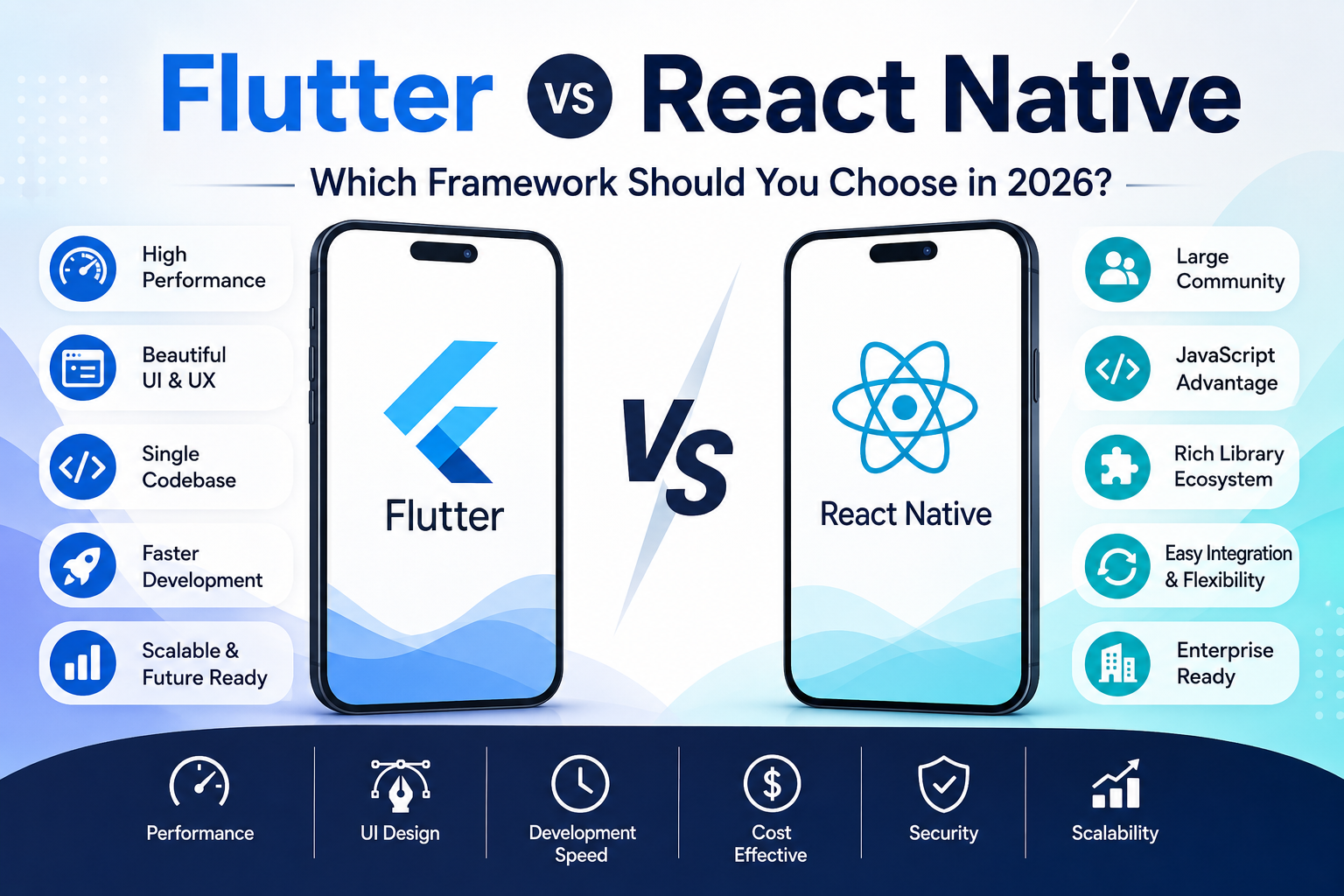
Flutter and React Native are the two leading cross-platform mobile app development frameworks in 2026. But which one is right for your project? In this comprehensive comparison, we analyze performance, development speed, scalability, UI capabilities, costs, security, and future trends to help startups, businesses, and enterprises choose the best framework for building successful mobile applications.
Key Takeaways
- Learn best practices and industry insights for mobile app development
- Understand implementation strategies with real-world examples
- Get practical tips and actionable advice from industry experts
Flutter vs React Native: Which Framework Should You Choose in 2026?
Choosing the right technology for mobile app development is one of the most important decisions for startups, enterprises, and business owners. The framework you select today will influence development speed, project cost, performance, scalability, maintenance, and user experience for years to come.
Two of the most dominant cross-platform app development frameworks in the market are Flutter and React Native. Both frameworks allow developers to build Android and iOS applications from a single codebase, reducing development time and costs while accelerating product launches.
However, many business owners, startup founders, and even technical teams often struggle to determine which framework is the better choice for their specific project.
In this comprehensive guide, we'll compare Flutter and React Native in depth, covering performance, scalability, development speed, programming languages, ecosystem support, UI capabilities, future trends, and real-world use cases to help you make an informed decision.
What is Flutter?
Flutter is Google's open-source UI toolkit designed to build beautiful, natively compiled applications for mobile, web, desktop, and embedded devices from a single codebase.
Released by Google in 2017, Flutter has rapidly become one of the most popular frameworks for cross-platform development because of its exceptional performance and highly customizable user interface capabilities.
Flutter uses the Dart programming language and includes its own rendering engine, allowing developers to create visually rich applications without relying heavily on native UI components.
Key Features of Flutter
- Single codebase for Android and iOS
- Hot Reload functionality
- Rich widget library
- High-performance rendering engine
- Custom UI development capabilities
- Strong support from Google
- Web and desktop application support
- Large package ecosystem
Popular Apps Built with Flutter
- Google Ads
- BMW
- Alibaba
- Toyota
- eBay Motors
- Google Pay
- Dream11
What is React Native?
React Native is an open-source framework developed by Meta (formerly Facebook) that enables developers to create mobile applications using JavaScript and React.
Launched in 2015, React Native quickly gained popularity because many web developers already had experience with JavaScript and React, making it easier to transition into mobile application development.
Unlike Flutter, React Native relies on native components and communicates through a bridge between JavaScript code and native platform APIs.
Key Features of React Native
- Single codebase development
- JavaScript-based architecture
- Large developer community
- Reusable code
- Third-party plugin support
- Strong ecosystem
- Fast development cycles
- Backed by Meta
Popular Apps Built with React Native
- Shopify
- Discord
- Walmart
- Bloomberg
Flutter vs React Native: Quick Comparison
| Feature | Flutter | React Native |
|---|---|---|
| Owner | Meta | |
| Programming Language | Dart | JavaScript |
| Performance | Excellent | Very Good |
| UI Customization | Outstanding | Good |
| Development Speed | Fast | Very Fast |
| Community Size | Growing Rapidly | Very Large |
| Learning Curve | Moderate | Easy |
| Native Feel | Excellent | Excellent |
| Web Support | Strong | Limited |
| Enterprise Scalability | Excellent | Excellent |
Programming Language Comparison: Dart vs JavaScript
One of the biggest differences between Flutter and React Native lies in the programming languages they use.
Dart (Flutter)
Dart is a modern programming language developed by Google. It was specifically optimized for building user interfaces and offers strong typing, excellent performance, and clean syntax.
Advantages of Dart include:
- High performance
- Strong type safety
- Easy debugging
- Predictable behavior
- Optimized for UI development
JavaScript (React Native)
JavaScript is the most widely used programming language in the world and powers millions of websites and applications.
Advantages include:
- Massive developer community
- Easy learning curve
- Large library ecosystem
- Easy hiring process
- Web and mobile development capabilities
For organizations with existing React or JavaScript teams, React Native may reduce onboarding costs significantly.
Performance Comparison
Performance remains one of the most important factors when selecting a mobile development framework.
Flutter Performance
Flutter compiles directly into native ARM code and includes its own rendering engine called Skia.
This allows Flutter applications to:
- Launch faster
- Render animations smoothly
- Maintain consistent frame rates
- Deliver near-native performance
Applications with complex animations, gaming elements, dashboards, and highly customized interfaces often perform exceptionally well in Flutter.
React Native Performance
React Native performs well for most business applications but relies on communication between JavaScript and native components.
While recent architectural improvements have significantly improved performance, extremely graphics-intensive applications may still require additional optimization.
Winner: Flutter
For raw performance and rendering consistency, Flutter generally holds a slight advantage.
User Interface and Design Flexibility
The visual experience of your application plays a major role in user engagement and retention.
Flutter UI Capabilities
Flutter provides complete control over every pixel displayed on the screen.
Developers can build:
- Custom dashboards
- Unique animations
- Advanced transitions
- Complex interactive interfaces
- Highly branded experiences
Because Flutter doesn't rely entirely on native components, developers can create consistent experiences across Android and iOS.
React Native UI Capabilities
React Native uses native UI components provided by each platform.
Benefits include:
- Native appearance
- Platform familiarity
- Reduced customization effort
However, highly customized designs may require additional development work.
Winner: Flutter
Flutter offers superior flexibility for custom UI design.
Development Speed
Time-to-market is critical for startups and businesses aiming to launch products quickly.
Both frameworks support Hot Reload, allowing developers to instantly see changes without rebuilding the application.
Flutter Development Speed
- Rich widget library
- Consistent UI system
- Fewer platform-specific issues
- Efficient development workflow
React Native Development Speed
- Large package ecosystem
- JavaScript familiarity
- Code reuse opportunities
- Faster onboarding
For teams already experienced in JavaScript, React Native may offer slightly faster development cycles.
Winner: React Native (Slight Edge)
Learning Curve
For developers entering mobile app development, the learning curve matters.
Flutter
Developers must learn:
- Dart
- Flutter widgets
- Flutter architecture
- State management
React Native
Developers familiar with:
- JavaScript
- React.js
- Web development
Can often transition quickly into React Native.
Winner: React Native
Community Support and Ecosystem
Community support is essential when solving technical challenges and accessing third-party resources.
Flutter Community
Flutter's community has grown rapidly and continues expanding globally.
Benefits include:
- Strong Google backing
- Extensive documentation
- Growing package ecosystem
- Active developer community
React Native Community
React Native benefits from:
- Millions of JavaScript developers
- Massive plugin ecosystem
- Years of community support
- Enterprise adoption
Winner: React Native
Part 1 Complete
In the next section, we'll cover:
- Scalability
- Security
- Enterprise Applications
- Startup Use Cases
- Cost Comparison
- Maintenance Requirements
- Real Business Examples
- SEO & Future Trends
Scalability: Which Framework Handles Growth Better?
When building a mobile application, it's important to think beyond the initial launch. A successful app will eventually need more users, more features, integrations, analytics, payment systems, and enterprise-level infrastructure.
This is where scalability becomes critical.
Flutter Scalability
Flutter has proven itself capable of supporting large-scale applications used by millions of users worldwide.
The framework supports:
- Modular architecture
- Advanced state management solutions
- Microservice integration
- Cloud-native deployment
- Enterprise-grade application structures
Companies like Google, Alibaba, BMW, and Toyota have successfully adopted Flutter for large-scale products.
Flutter's consistent rendering engine also makes scaling design systems significantly easier because UI behavior remains predictable across devices.
React Native Scalability
React Native has also demonstrated excellent scalability and powers applications used by hundreds of millions of users.
Major companies including Meta, Instagram, Shopify, Discord, and Walmart continue investing heavily in React Native.
React Native offers:
- Strong enterprise adoption
- Mature development practices
- Flexible architecture
- Large engineering talent pool
- Excellent cloud integration capabilities
Winner: Tie
Both Flutter and React Native are capable of supporting enterprise-scale applications. The choice depends more on business requirements than technical limitations.
Security Comparison
Security is one of the most important considerations for modern mobile applications, especially when handling user data, payments, healthcare information, or financial transactions.
Flutter Security Features
- Secure code compilation
- Strong type safety with Dart
- Reduced runtime errors
- Encrypted local storage options
- Secure API integrations
Flutter's compiled architecture reduces some vulnerabilities associated with interpreted languages.
React Native Security Features
- Secure storage libraries
- Biometric authentication support
- SSL pinning options
- Native security integrations
- Enterprise security frameworks
React Native security largely depends on implementation quality and the third-party packages being used.
Winner: Flutter (Slight Edge)
Due to Dart's strong typing and compiled nature, Flutter offers a slight security advantage, though both frameworks can achieve enterprise-grade security.
Cost of Development: Flutter vs React Native
Cost is often a deciding factor for startups and growing businesses.
One reason both frameworks are so popular is because they significantly reduce development costs compared to building separate native Android and iOS applications.
Flutter Development Costs
Flutter enables:
- Single codebase development
- Reduced maintenance expenses
- Faster UI implementation
- Lower testing costs
- Cross-platform deployment
Because Flutter controls its own rendering engine, developers often spend less time solving platform-specific UI inconsistencies.
React Native Development Costs
React Native can also reduce development expenses significantly.
Advantages include:
- Larger developer pool
- Easier hiring process
- Faster onboarding
- Abundant third-party libraries
- Existing JavaScript expertise
Which Is More Affordable?
For companies already using JavaScript technologies, React Native may be slightly more cost-effective.
For highly customized applications, Flutter often delivers better value due to reduced UI development complexity.
Winner: Depends on Team Structure
Maintenance and Long-Term Support
Launching an application is only the beginning. Long-term maintenance often accounts for a significant portion of a product's lifecycle cost.
Flutter Maintenance
Flutter's consistent architecture helps reduce maintenance challenges.
Benefits include:
- Single UI rendering system
- Consistent platform behavior
- Predictable updates
- Stable package ecosystem
Google's continued investment in Flutter also strengthens confidence in its long-term future.
React Native Maintenance
React Native applications may occasionally require additional maintenance due to:
- Native dependency updates
- Third-party package compatibility
- Platform-specific changes
- Bridge-related issues
However, the mature ecosystem often provides solutions quickly.
Winner: Flutter
Enterprise Application Development
Enterprise applications typically require:
- High security
- Scalability
- Integration capabilities
- Long-term support
- Performance consistency
When Enterprises Choose Flutter
- Custom business applications
- Financial platforms
- Healthcare systems
- Internal enterprise tools
- High-performance dashboards
When Enterprises Choose React Native
- Existing React ecosystems
- Rapid product deployment
- Customer-facing applications
- Marketplace platforms
- Social networking products
Both frameworks are enterprise-ready in 2026.
Flutter for Startups
Startups often prioritize:
- Speed
- Budget efficiency
- Product-market fit validation
- Scalability
- Investor readiness
Flutter offers startups a powerful combination of rapid development and excellent user experience.
Advantages for Startups
- Single codebase
- Beautiful interfaces
- Lower development costs
- Fast MVP creation
- Future scalability
Many startups choose Flutter because it enables them to launch polished products quickly without maintaining separate development teams.
React Native for Startups
React Native remains a favorite among startups due to the widespread availability of JavaScript developers.
Advantages for Startups
- Large hiring pool
- Fast development cycles
- Strong community support
- Extensive library ecosystem
- Lower onboarding costs
If your startup already uses React for web development, React Native can create significant efficiencies.
Third-Party Libraries and Plugins
Modern applications rely heavily on external libraries for features such as:
- Authentication
- Payments
- Maps
- Notifications
- Analytics
- Chat systems
- Cloud services
Flutter Ecosystem
Flutter's package repository, Pub.dev, has grown rapidly and now contains thousands of high-quality packages.
Popular integrations include:
- Firebase
- Stripe
- Google Maps
- AWS Services
- OpenAI APIs
- Payment gateways
React Native Ecosystem
React Native benefits from years of ecosystem maturity.
Developers have access to:
- Massive NPM package ecosystem
- Thousands of community libraries
- Open-source solutions
- Enterprise-grade integrations
Winner: React Native
React Native still maintains a slight ecosystem advantage because of JavaScript's widespread adoption.
Developer Availability and Hiring
Finding experienced developers impacts both project cost and hiring speed.
Flutter Developers
Flutter developer demand continues growing rapidly worldwide.
However, the available talent pool remains smaller than JavaScript.
React Native Developers
React Native benefits from millions of JavaScript developers globally.
Hiring React Native developers is generally easier and faster.
Winner: React Native
Testing and Debugging Experience
Both frameworks provide robust testing capabilities.
Flutter Testing
- Unit Testing
- Widget Testing
- Integration Testing
- Performance Testing
Flutter's testing ecosystem is highly structured and developer-friendly.
React Native Testing
- Jest Testing
- Unit Testing
- Integration Testing
- End-to-End Testing
React Native's mature ecosystem provides excellent testing solutions.
Winner: Tie
Part 2 Complete
In Part 3, we'll cover:
- SEO and Web Capabilities
- Future of Flutter in 2026 and Beyond
- Future of React Native
- Industry-Specific Recommendations
- Flutter vs React Native Use Cases
- Real-World Business Examples
- Detailed Decision Framework
- Expert Recommendation
SEO and Web Capabilities
As businesses increasingly adopt omnichannel strategies, the ability to extend applications beyond mobile devices becomes a major advantage.
Many organizations today want their application ecosystem to support:
- Mobile Applications
- Web Applications
- Admin Dashboards
- Customer Portals
- Progressive Web Apps (PWAs)
- Desktop Applications
Flutter Web Capabilities
Flutter has made significant improvements in web development and now supports:
- Progressive Web Applications
- Interactive Dashboards
- Customer Portals
- Internal Business Tools
- Web-Based SaaS Platforms
Organizations can reuse substantial portions of their Flutter codebase across mobile and web applications, reducing development costs and accelerating product launches.
React Native Web Capabilities
React Native itself is primarily focused on mobile development. However, businesses using React Native often pair it with React.js for web development.
This approach works effectively but generally requires:
- Additional development effort
- Separate UI implementation
- Increased maintenance overhead
Winner: Flutter
For businesses planning a unified mobile, web, and desktop strategy, Flutter offers stronger long-term advantages.
Future of Flutter in 2026 and Beyond
Flutter continues to receive substantial investment from Google and has become one of the fastest-growing development frameworks globally.
Major Growth Factors
- Google ecosystem support
- Strong enterprise adoption
- Growing startup popularity
- Web and desktop support
- AI-powered application development demand
- Cross-platform efficiency
As businesses seek cost-effective development solutions, Flutter's single-codebase architecture positions it strongly for future growth.
Industries Driving Flutter Adoption
- FinTech
- Healthcare
- Education Technology
- E-commerce
- Travel Platforms
- SaaS Applications
- Enterprise Software
Industry analysts expect Flutter adoption to continue growing significantly throughout 2026 and beyond.
Future of React Native in 2026 and Beyond
React Native remains one of the most widely used cross-platform development frameworks in the world.
Meta continues investing heavily in:
- Performance improvements
- Developer tooling
- Native architecture modernization
- Framework optimization
Key Strengths Driving Future Growth
- Massive JavaScript ecosystem
- Strong enterprise adoption
- Large talent pool
- Web and mobile synergy
- Rapid development cycles
React Native will likely remain a dominant force for companies already invested in JavaScript technologies.
Industry-Specific Recommendations
The ideal framework often depends on the industry and project requirements.
E-Commerce Applications
Recommended Framework: Flutter
E-commerce applications benefit from:
- Beautiful interfaces
- Smooth animations
- High-performance product browsing
- Custom shopping experiences
Food Delivery Applications
Recommended Framework: Flutter
Food delivery platforms require:
- Real-time tracking
- Map integration
- Push notifications
- Order management systems
- Performance optimization
Social Media Platforms
Recommended Framework: React Native
Social applications often benefit from:
- Real-time communication
- JavaScript ecosystem advantages
- Rapid feature deployment
Healthcare Applications
Recommended Framework: Flutter
Healthcare applications require:
- Security
- Performance
- Stable user interfaces
- Long-term maintainability
SaaS Platforms
Recommended Framework: Both
The choice depends on:
- Existing technology stack
- Developer availability
- Product complexity
- Future roadmap
Flutter vs React Native for Startups
Most startups have three priorities:
- Launch quickly
- Reduce costs
- Validate market demand
Flutter is often preferred for startups building visually rich products because it enables rapid MVP development without sacrificing user experience.
React Native is frequently chosen when:
- The team already uses React
- JavaScript expertise exists internally
- Fast hiring is a priority
Flutter vs React Native for Enterprises
Large organizations typically focus on:
- Scalability
- Security
- Maintainability
- Long-term ROI
Both frameworks satisfy enterprise requirements successfully.
However:
- Flutter excels in custom UI-heavy solutions.
- React Native excels in JavaScript-centric ecosystems.
Real-World Business Examples
When Flutter Was the Better Choice
Imagine a startup launching a food delivery platform similar to Uber Eats or DoorDash.
The application requires:
- Live order tracking
- Complex animations
- Real-time notifications
- Multiple user roles
- High-performance dashboards
Flutter's rendering engine provides excellent performance for these requirements.
When React Native Was the Better Choice
Consider a SaaS company already operating:
- React.js web application
- Node.js backend
- JavaScript development team
Using React Native allows the company to leverage existing expertise and accelerate development.
Decision Framework: Which One Should You Choose?
| Scenario | Recommended Framework |
|---|---|
| Custom UI & Animations | Flutter |
| Existing JavaScript Team | React Native |
| Fast MVP Development | Both |
| Food Delivery App | Flutter |
| E-Commerce App | Flutter |
| Social Media App | React Native |
| Enterprise Software | Both |
| Healthcare App | Flutter |
| SaaS Platform | Both |
| Startup with React Team | React Native |
Frequently Asked Questions (FAQ)
Is Flutter better than React Native?
Neither framework is universally better. Flutter offers superior UI customization and performance, while React Native benefits from JavaScript's ecosystem and developer availability.
Which framework is faster?
Flutter generally delivers slightly better performance due to direct compilation and its own rendering engine.
Which framework is easier to learn?
React Native is typically easier for developers already familiar with JavaScript and React.
Can Flutter replace native development?
For most business applications, Flutter can effectively replace separate Android and iOS development while reducing costs and timelines.
Can React Native handle enterprise applications?
Yes. Many global enterprises successfully use React Native to power large-scale applications.
Which framework is more future-proof?
Both frameworks have strong backing from major technology companies and are expected to remain relevant for many years.
Expert Recommendation
If your primary goal is building highly customized, visually stunning, performance-driven applications, Flutter is often the better choice.
If your organization already relies heavily on JavaScript technologies and React.js, React Native may provide faster development and easier team adoption.
For most startups and modern businesses launching new products in 2026, Flutter currently offers a slight advantage due to:
- Superior UI flexibility
- Consistent performance
- Excellent scalability
- Web and desktop support
- Growing enterprise adoption
Conclusion
The Flutter vs React Native debate continues because both frameworks are outstanding solutions for cross-platform mobile development.
Flutter delivers exceptional performance, beautiful interfaces, and powerful customization capabilities, making it ideal for businesses that prioritize user experience and long-term scalability.
React Native provides access to the world's largest developer ecosystem, faster onboarding, and strong integration with existing JavaScript applications.
Ultimately, the best framework depends on your business objectives, team expertise, project requirements, timeline, and budget.
Before making a final decision, evaluate your product roadmap, growth expectations, technical resources, and user experience goals.
A well-chosen framework can significantly reduce development costs, accelerate time-to-market, and provide a strong foundation for future growth.
Need Expert Mobile App Development Services?
At Sell Tech Ind. Productions, we specialize in building scalable, high-performance mobile applications using both Flutter and React Native.
Our services include:
- Flutter App Development
- React Native Development
- Android Application Development
- iOS Application Development
- Food Delivery Applications
- E-Commerce Platforms
- SaaS Product Development
- Healthcare Applications
- AI-Powered Mobile Solutions
- Custom Software Development
Whether you're a startup, enterprise, restaurant, healthcare provider, SaaS company, or growing business, our team can help transform your idea into a scalable digital product.
Website: https://www.selltechindproductions.in
Email: info@selltechindproductions.in
Sell Tech IND.
Sell Tech IND. Productions Team
We are a technology-driven company specializing in software development, web development, mobile apps, SaaS solutions, blockchain, AI, and digital marketing.
Stay Updated
Get the latest tech insights, tutorials, and industry news delivered straight to your inbox.
No spam, ever. Unsubscribe anytime.